 Nov 26, 2026
How to Choose the Right Valet Parking Software for Your Business
Valet parking constitutes a pivotal element of the customer experience across a diverse array of enterprises.
Be it a hotel orchestrating the arrival of guests, a shopping center regulating foot traffic, a medical facility managing patient intakes, or a commercial complex accommodating numerous visitors, a meticulously organized valet service can yield a discernible and significant enhancement in operational efficacy and visitor satisfaction.
Nevertheless, the administration of valet parking extends far beyond the simple reception of vehicle keys and the placement of automobiles; it necessitates a seamless integration of staff coordination, vehicle tracking systems, ticket management protocols, the fulfillment of customer requests, and the orchestration of daily operational activities.
Amidst business expansion and increasingly stringent parking mandates, reliance on manual management methods often proves insufficient.
In such scenarios, implementing valet parking software offers a decisive solution to streamline operations.
Amidst a proliferation of distinct solutions readily accessible in the marketplace, how does one discern the optimal choice tailored to the specific exigencies of their enterprise?
The appropriate solution is contingent upon your operational mandates, the requisite feature set, the composition of your valet personnel, and the desired degree of managerial oversight provided by the software.
This guide examines the critical considerations enterprises must evaluate prior to committing resources to a valet parking management system.
1.Understand Your Business's Valet Parking Requirements
Prior to evaluating potential software vendors, it is essential to conduct a comprehensive analysis of the mechanics and workflow of your existing valet parking operation.
Parking mandates vary significantly across diverse commercial sectors, necessitating tailored management strategies.
For instance, hospitality establishments must optimize the workflow of guest arrivals and vehicle retrieval to ensure seamless operations, whereas shopping centers often contend with surges in vehicular traffic concentrated on weekends and holidays.Furthermore, the operational priorities of medical facilities and other commercial properties frequently diverge, reflecting their unique functional requirements.
Begin by pinpointing the deficiencies within your current operational framework.
Consider questions such as:
- Could you specify the daily volume of vehicles managed by your team?
- What is the total number of valet attendants engaged in this operation?
- Does your facility oversee parking operations from a single site or across multiple locations?
- Do you presently rely on paper tickets or manual record-keeping systems?
- How do you track vehicle drop-offs and retrieval requests?
- What information does management need to monitor regularly?
Grasping these prerequisites enables you to discern which software functionalities are indispensable and which remain supplementary.
While a strategy proving effective for a compact parking facility may fall short when applied to a vast property encompassing multiple teams and diverse locations, such scalability cannot be assumed.
2. Evaluate the Essential Features
A pivotal consideration in selecting valet parking software lies in comprehensively evaluating the platform's functional capabilities.
Do not prioritize a solution solely on the volume of advertised features; rather, assess whether those capabilities genuinely align with your specific operational necessities.
Here are some capabilities worth evaluating:
Digital ticket management
Implementing a digital ticketing framework significantly diminishes reliance on paper-based documentation while streamlining the identification and retrieval of vehicles.
To fully leverage this system, it is essential to examine its operational mechanics regarding the generation, storage, and administration of vehicle tickets.
Vehicle tracking
The software must facilitate the comprehensive documentation of vehicle particulars and the real-time surveillance of their condition throughout the valet service.
It is essential to delineate precisely which data points are recorded and to define the mechanisms by which personnel retrieve and utilize this information.
Valet staff management
Overseeing personnel duties constitutes a critical component of daily operational efficiency.
It is imperative to assess whether the platform effectively facilitates the requisite workflows for synchronizing vehicle management protocols with staff operational activities.
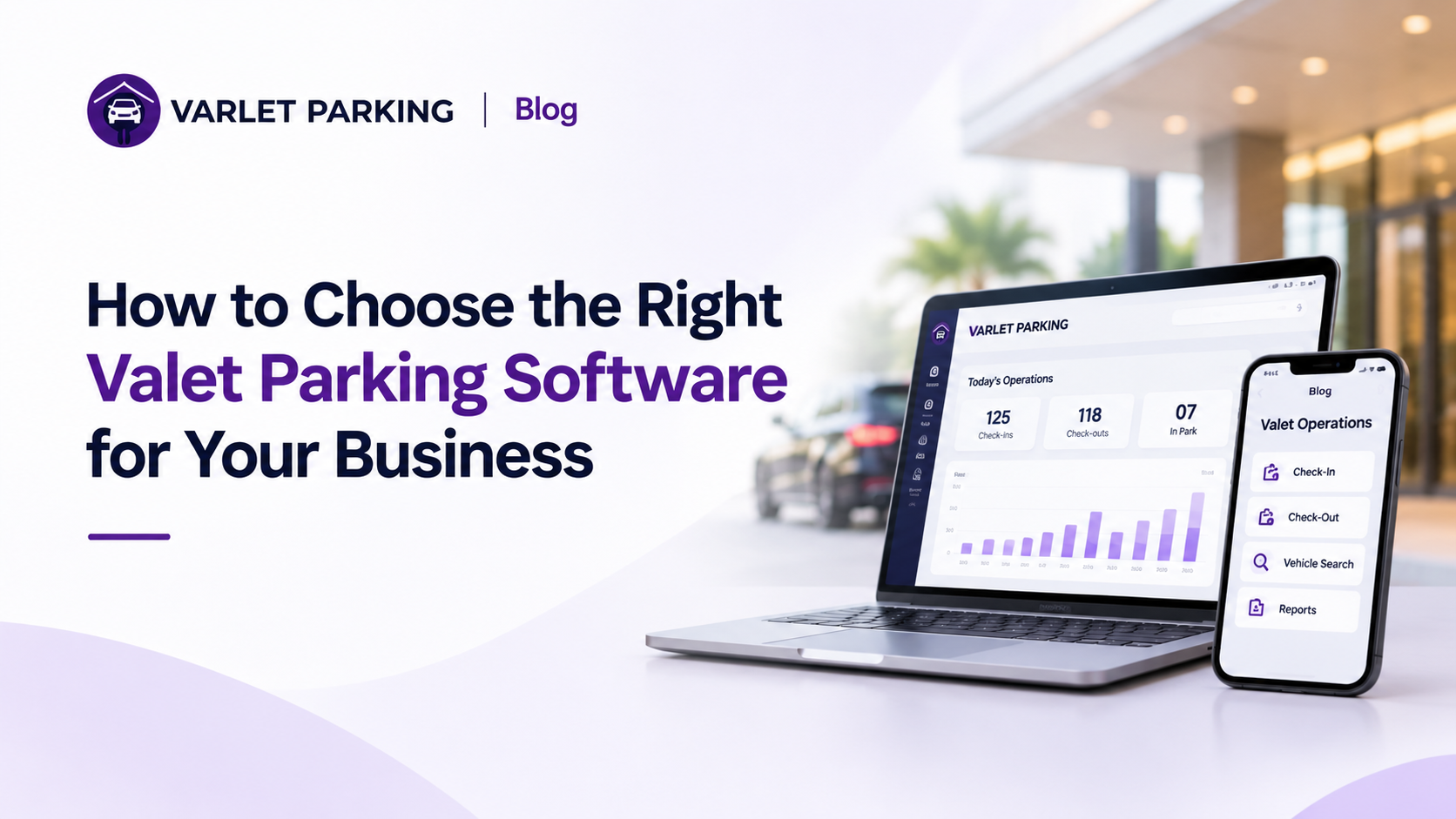
Management dashboard
An effective dashboard must facilitate streamlined access to pertinent operational data for authorized managerial personnel.
Consequently, it is imperative to ascertain the scope of available information and evaluate whether it can be presented in a format that is both lucid and pragmatically actionable.
Reporting and activity records
Reports serve as a critical instrument for management to comprehend daily operational dynamics and evaluate overall performance.
It is imperative to ascertain the specific reports accessible within the system, verify their export capabilities, and determine the methodologies for selecting appropriate reporting periods.
The optimal configuration of features is contingent upon your specific business model; therefore, it is prudent to prioritize tangible utility over an excessively extensive and superfluous inventory of capabilities.
3. Evaluate User Friendliness and Staff Integration
Despite the comprehensive capabilities of a sophisticated valet parking system, operational inefficiencies can arise if the staff struggle to navigate its complex interface.
Valet attendants frequently operate within high-velocity settings, necessitating the swift processing of vehicle arrivals and retrieval demands.
Consequently, an intricate user interface can impede daily operational efficiency and substantially complicate staff training protocols.
Prior to selecting a service provider, it is imperative to solicit a demonstration of the application itself.
Pay attention to:
- The extent to which the interface is intuitive and readily comprehensible.
- The velocity with which personnel execute routine operations.
- Whether critical data is readily accessible.
- The operational mechanics of the system on the devices utilized by your team function as follows.
- The capacity for new hires to master the operational procedures with minimal extensive training warrants consideration.
Furthermore, it is imperative to engage the individuals who will operate the system on a daily basis within the evaluation framework.
Input feedback can assist in uncovering practical impediments that often remain obscured during formal management presentations.
4. Look for Management Visibility and Reporting
For proprietors and operations managers, the oversight of valet services extends far beyond the mere mechanics of vehicle placement and retrieval; it necessitates a comprehensive degree of transparency regarding daily operational dynamics.
An effective valet parking management system must ensure that pertinent operational data remains readily accessible to all authorized personnel.
The specific utility of the data varies by platform, potentially encompassing vehicle performance metrics, ticketing histories, personnel operational logs, and comprehensive operational summaries.
Before making a decision, ask the provider:
- What information is available through the management dashboard?
- Can managers review historical activity?
- Are reports available for different time periods?
- Is it possible to segregate data based on geographical parameters or other pertinent classifications?
- Which users are permitted to access management information?
Effective reporting facilitates more rigorous operational assessments, enabling managers to pinpoint specific domains requiring targeted attention.
Nevertheless, ensure that the reporting functionalities align precisely with the specific informational requirements of your enterprise.
5. Check Scalability and Multi-Location Support
Contemporary business imperatives are not necessarily indicative of future necessities.
When assessing a valet parking solution, it is imperative to examine not only its capacity to support existing operational demands but also its scalability to accommodate anticipated future expansion.
Consequently, a hotel conglomerate might progressively deploy this system across its diverse portfolio of properties.
Similarly, a parking management entity could assume oversight of further sites, while a retail complex might broaden its parking infrastructure to accommodate increased visitor traffic.
Under such circumstances, the capacity to orchestrate operational activities across diverse geographic sites emerges as a critical imperative.
Ask potential software providers:
- Can the platform support multiple locations?
- Is it permissible for management to examine location-specific data?
- Can user permissions be configured for different teams?
6. Evaluate Integrations and Compatibility
Modern businesses often use several digital systems to manage their daily operations. Depending on the business, these may include property management systems, payment platforms, customer management software, access control systems and other operational tools. If your valet parking software needs to work alongside existing systems, compatibility should be checked before purchasing. Not every software provider supports every integration. Therefore, ask specific questions about the systems you currently use.
Find out:
- Which integrations are available?
- Are integrations included or charged separately?
- Is an API available for custom integration requirements?
- Are there additional technical requirements?
- Who will be responsible for implementation and support?
Do not assume that an advertised integration is automatically available for your particular software version or business setup. Request confirmation from the provider.
7. Assess Security and Data Management
Valet parking operations involve information about vehicles, customers and employees. Businesses should understand how a software provider handles this information. Security should be considered an important part of the software evaluation process, not something to review after implementation.
Questions worth asking include:
- How is business and customer information stored?
- What user access controls are available?
- Can permissions be assigned according to staff responsibilities?
- Are backups and data recovery processes in place?
- How are software updates and security issues handled?
Also ask whether the provider can explain its data handling practices and any relevant security measures. A clear understanding of data management helps businesses make more informed technology decisions.
8. Understand Pricing and Long-Term Value
Software pricing is another important factor, but the lowest-priced option is not always the most suitable. Different providers may follow different pricing models. Some may charge a subscription fee, while others may have separate charges for setup, additional users, integrations or support. When comparing quotations, look beyond the advertised monthly or annual price.
Consider the complete cost of ownership, including:
- Initial setup and implementation.
- Subscription or licensing fees.
- Additional user or location charges.
- Integration and customisation costs.
- Training and onboarding.
- Ongoing maintenance and technical support.
You should also consider the operational value the software is expected to provide. For example, if a digital system helps your team organise vehicle records, reduce manual administration or improve management visibility, these benefits may be relevant when evaluating the investment. Ask providers to explain all charges clearly so that you can compare solutions on a consistent basis.
9. Evaluate Customer Support and Implementation
Selecting the software is only one part of the process. A successful implementation also depends on how well the provider supports your business. Your team may need assistance during setup, staff onboarding, configuration and the transition from existing processes.
Before signing an agreement, understand what support is included. Ask about: Initial setup and configuration assistance.
- Staff training and onboarding.
- Technical support availability.
- Response times for reported issues.
- Software updates and maintenance.
- Assistance when business requirements change.
It is also useful to understand whether support is available through channels that are convenient for your team. A provider that can clearly explain its implementation and support process makes it easier for your business to plan the transition.
10. Request a Live Demo Before Making a Decision
Product descriptions and feature lists can provide an overview, but they cannot replace a practical demonstration. A live demo allows your management team to understand how the software works in a real operational context. Rather than asking the provider to show every available feature, request a demonstration based on your actual business requirements.
For example, ask them to demonstrate:
- How a vehicle is registered when it arrives.
- How the vehicle information is recorded.
- How staff manage the parking and retrieval process.
- How managers review operational information.
- How different users access the system.
Prepare a list of questions before the meeting and involve relevant members of your operations team. If possible, request a trial or pilot arrangement to evaluate the software in your own working environment. A practical evaluation can help you make a decision based on actual usability rather than marketing promises.
Questions to Ask Before Choosing a Valet Parking Software Provider
Before finalising a provider, use this checklist to compare your shortlisted solutions.
- Does the software support our current valet parking workflow?
- Is the application easy for staff to use? What vehicle and ticket information can be recorded?
- What management reports and dashboards are available?
- Can the system support multiple locations? Which integrations are supported?
- What security and access controls are available?
- What are the complete subscription and implementation costs?
- What training and technical support are included?
- Can we see a live demonstration before purchasing?
Comparing providers using the same questions can make the selection process more objective and help your business avoid choosing a solution based on price or presentation alone.
Conclusion: Choose a Solution That Fits Your Operations
Choosing the right valet parking software is an important decision for businesses that depend on organised vehicle handling and efficient parking operations. The best solution is not necessarily the one with the longest feature list or the lowest subscription fee. It is the one that fits your operational requirements, supports your team, provides useful management visibility and can accommodate your future needs. Take time to understand your current challenges, evaluate the available features, compare providers and request a live demonstration before making your investment. With the right digital approach, businesses can move towards more structured valet parking operations and provide their teams with better tools to manage daily activities. Discover VarletPark Looking for a digital solution to manage your valet parking operations? VarletPark is a valet parking management platform designed to support businesses in organising their valet operations through digital technology. Explore VarletPark to understand how its available features and workflows align with your business requirements. Interested in seeing how VarletPark works? Contact our team to schedule a personalised demo.
Discover VarletPark
Looking for a digital solution to manage your valet parking operations?
VarletPark is a valet parking management platform designed to support businesses in organising their valet operations through digital technology.
Explore VarletPark to understand how its available features and workflows align with your business requirements.
Interested in seeing how VarletPark works? Contact our team to schedule a personalised demo.